Passage 03 / Prepared feedstock → conversion product
Conversion: Heat Is Only Part of It
The right route depends on the polymer, its condition and the intended output. A process name alone says little about usable yield or environmental performance.
Mechanical recycling preserves the backbone
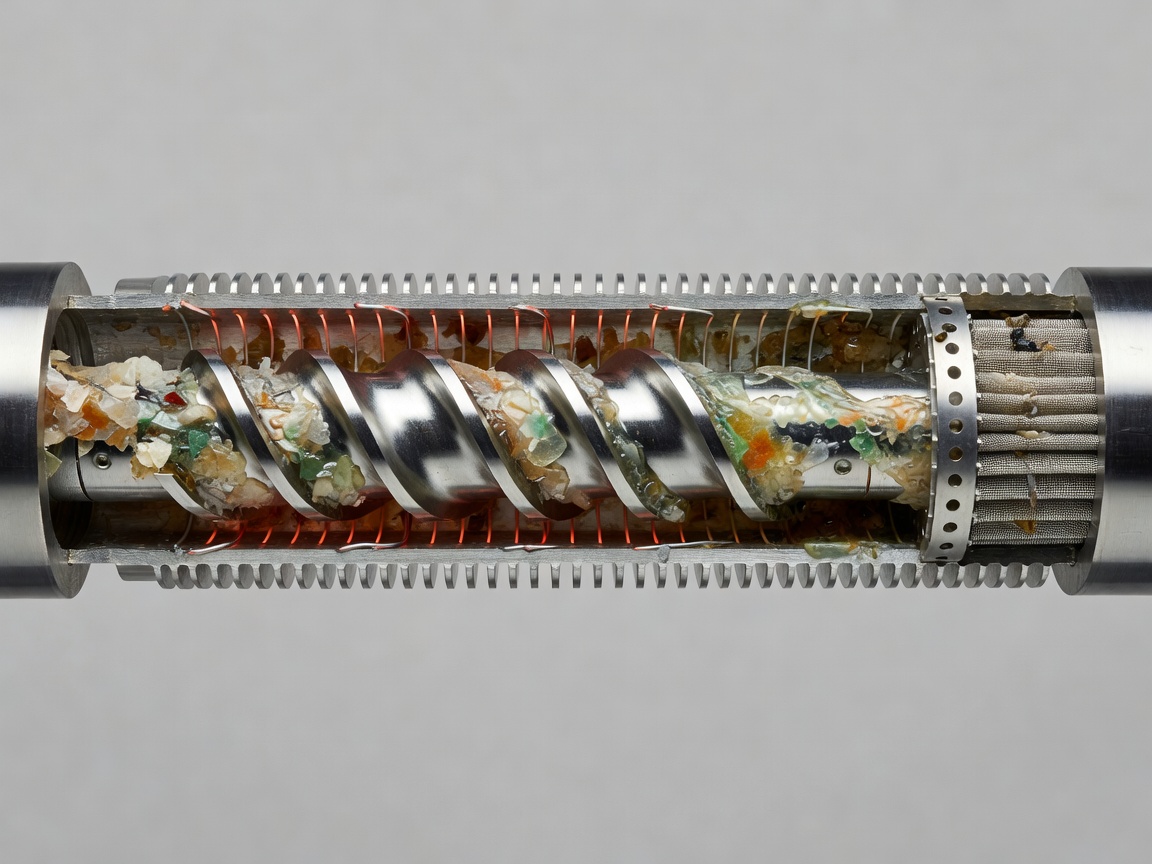
Mechanical recycling commonly turns sorted, washed and dried thermoplastic into flake, regrind or pellets for another manufacturing operation. Extrusion heats and shears the polymer so it can flow through filters and a die. Cooling and cutting then produce a more manageable feedstock. Some applications use prepared material without a separate pelletising stage.
This route largely preserves the polymer's chemical identity, but processing is not neutral. Heat, oxygen, moisture and shear can change molecular structure and properties. Previously weathered material may have a narrower processing window than a controlled industrial scrap stream. Stabilisation and careful operating conditions can help, but cannot justify assuming original performance.
Melt filtration captures certain solid contaminants above the effective screen size. It does not reliably remove dissolved chemicals, incompatible polymers that also melt or all sources of odour. Degassing can reduce some moisture and volatile components, but its effectiveness depends on equipment and operating conditions. Each claimed improvement needs an appropriate test.
Compounding makes an agreed grade
A compounder may blend batches, add stabilisers, introduce fillers or use compatibilisers to achieve an application-specific balance. These interventions should be documented. A product described as recycled material may contain additives or other polymer fractions, so recycled content must be stated on a defined basis.
Compatibilisation can improve the behaviour of certain polymer mixtures; it is not a general permission to ignore sorting. A formulation that performs adequately in a thick outdoor component may fail in a thin film, a demanding structural part or a regulated contact application. The manufacturing trial remains part of qualification.
For buyers, the useful question is whether a supplier can repeatedly deliver the agreed grade. An impressive single sample cannot establish consistency across changing marine collections. Lot release data, retained samples and a procedure for out-of-specification production make the conversion claim operationally meaningful.
Chemical routes are not one technology
Depolymerisation deliberately breaks suitable polymers into smaller chemical building blocks that may be purified and used again. The chemistry is polymer-specific. Nylon 6 regeneration, for example, is not an interchangeable route for every fishing net: nylon 6, nylon 6,6, polyethylene and mixed constructions require different treatment decisions.
Aquafil's ECONYL system is a real-world example of nylon 6 regeneration using selected waste streams, which can include fishing nets alongside other inputs. Its existence demonstrates a particular route, not the universal recyclability of marine litter. Buyers should ask which inputs support a specific product claim and how those inputs are accounted for.
Other processes, including pyrolysis, produce mixtures that may need substantial upgrading before entering chemical manufacturing. Chlorine-containing materials, metals and other contaminants can create serious constraints. An oil-like product is not itself proof that waste has become new plastic.
Follow the destination, not just the reactor
Distinguish material recycling from fuel production or energy recovery. If a conversion output is ultimately burned, its destination differs from an output demonstrably incorporated into a new polymer. Applicable legal definitions and accounting rules also matter; a broad marketing label should not substitute for that distinction.
Some supply chains use mass-balance allocation when recycled and other inputs share processing infrastructure. Such an accounting model can support defined claims under a particular scheme, but it should not be presented as physical segregation. Ask for the allocation rules, system boundary, verification arrangements and exact wording permitted for the final product.
Environmental comparison requires a consistent basis. Feedstock preparation, electricity and heat sources, product yields, upgrading, residue handling and the displaced product all influence results. A route cannot be declared better solely because it is mechanical or chemical. Similarly, nameplate capacity is not proof of current annual production.
A facility dossier should therefore identify accepted material, demonstrated operating status, intermediate and final outputs, and the evidence behind yield claims. Where information is missing, the honest conclusion is uncertainty rather than an assumption that every collected kilogram becomes useful polymer.
| Route | Intended transformation | Critical question |
|---|---|---|
| Mechanical | Physical reprocessing of a polymer | Does the resulting grade meet a buyer's specification? |
| Depolymerisation | Selected polymer to recoverable building blocks | Is the feedstock chemically suitable and purification demonstrated? |
| Thermochemical conversion | Plastic to a mixture of smaller molecules | What share reaches new material rather than fuel? |
| Dissolution-based purification | Separate a polymer using a solvent system | Are solvent recovery and residuals controlled? |
Evidence bench
- ECONYL and Aquafil — primary operator descriptions of nylon regeneration.
- PLASTIX — an operator example of mechanical recycling for maritime plastics.
- European Commission: Waste Framework Directive — context for waste hierarchy and treatment definitions.